Kisspeptin and bone turnover
This is the chapter whose small print most deserves a wide margin: who was studied, and what moved in the blood.
The acute study in healthy men
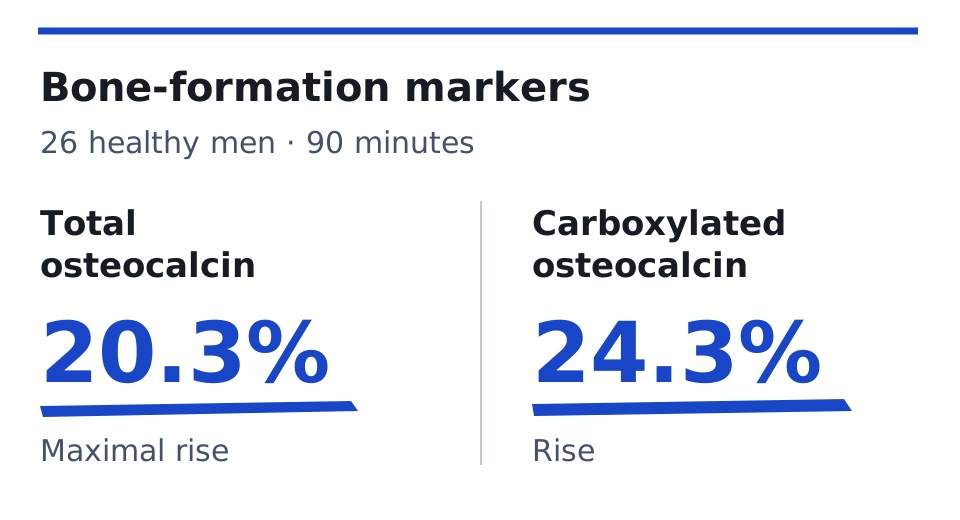
In an acute kisspeptin study in 26 healthy eugonadal men, researchers measured bone-formation markers during a 90-minute intravenous infusion. They reported a 20.3% maximal rise in total osteocalcin and a 24.3% rise in carboxylated osteocalcin.
Osteocalcin is the bone-formation marker being measured here. For this experiment, the particular measurements deserve priority over a broad phrase such as bone support. They give the experiment a defined result, in healthy men, over a brief observation period.
I initially underestimated this experiment. Its narrowness seemed like a weakness until I considered the precision of the question: can administering kisspeptin alter these markers acutely? The reported increases make a possible skeletal action worth pursuing. That is the research lead that interests me.
Bone removal in the mouse experiment
A separate mouse study examined kisspeptin-10 and osteoclast activity. Osteoclasts are the cells involved in bone resorption, the removal of bone. Kisspeptin-10 binding to Gpr54 upregulated Dusp18 in the reported pathway and suppressed osteoclast activity. Mice lacking Kiss1, Gpr54 or Dusp18 showed osteoclast hyperactivation and bone loss; kisspeptin-10 abrogated bone loss in vivo.
That is a mouse result. The bone-removal findings draw me into this mouse experiment; the human experiment measured markers of formation. The papers approach skeletal biology from different directions. I would be cautious about flattening them into a single percentage or a single advertised benefit.
The menopause question
The human study concerns an acute response in healthy men, and the bone-loss intervention concerns mice. A study enrolling postmenopausal women would have to supply its own results.
I am left with concrete questions. Would a change in these markers persist? Would the bone-loss findings translate into a useful outcome in women? Those questions make this a worthwhile chapter to follow, even while the answer for menopause remains unwritten.
That separation also clarifies my enthusiasm. The biology excites me; a benefit for a particular group still needs evidence from that group. On kisspeptin and bone, that is as far as my confidence currently reaches. The reproductive-signalling chapter supplies some of the molecule's less tidy history.